
Easter or Empire?
Empire’s grasp is as strong as ever, and yet... an alternative Easter message persists.

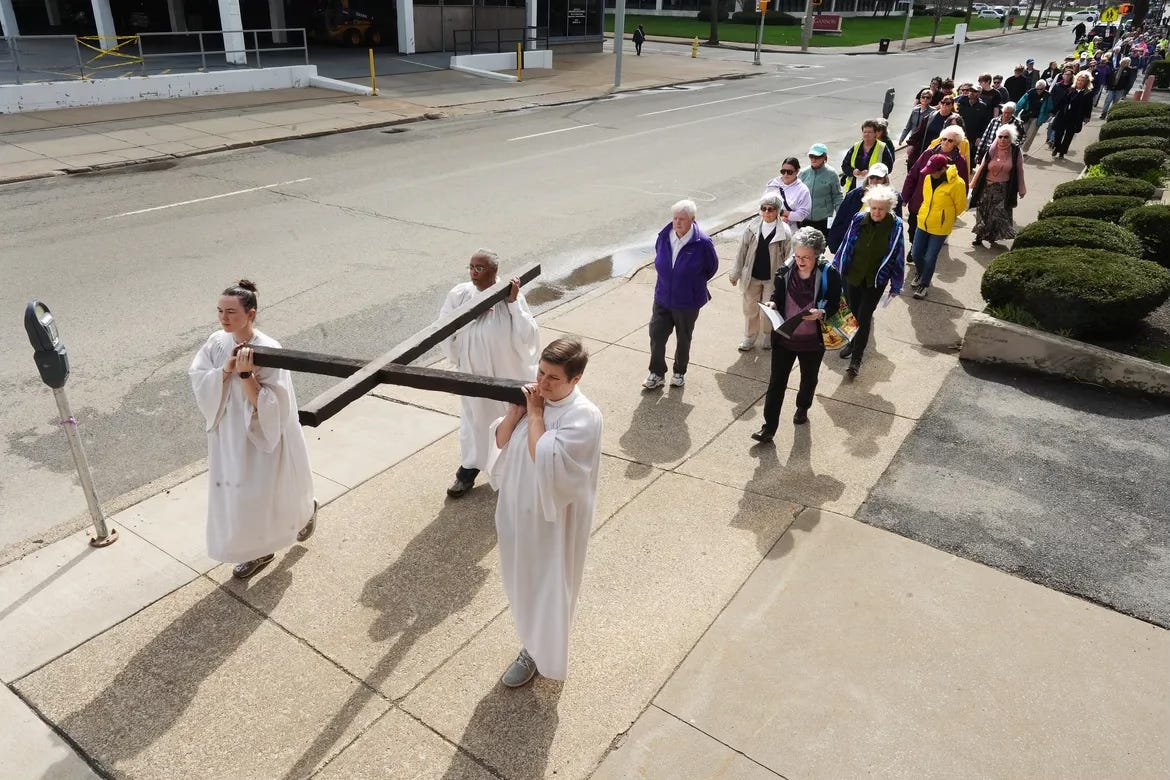
This past Friday, I joined over a hundred others for a Good Friday Peace Pilgrimage through downtown Erie. We walked from the Catholic Cathedral to the County Courthouse, the Federal Building to the Social Security Office, and on, as we were invited to consider how Christ is being crucified today, in our own city, manifest in and through our systems and institutions. The parallel was drawn clearly: the state violence of our own time and the state violence that crucified Jesus are cut from the same cloth—empire that seeks control and domination, at any cost.
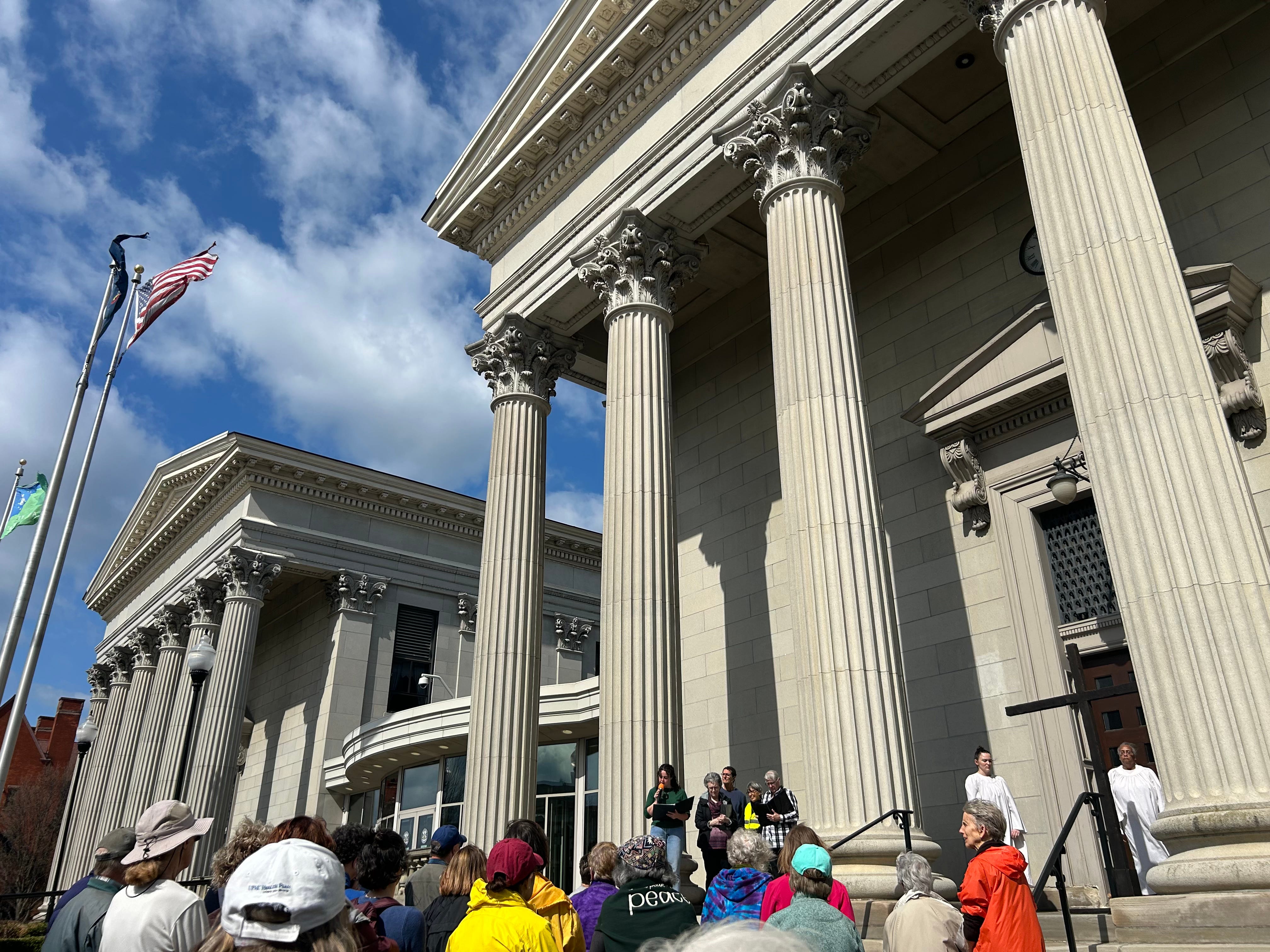
About thirty minutes into the two-hour walk, between two of the stations, people from our group began to notice a man across the street from us, holding a sign with a quote from scripture on it, and he began to shout toward us. Loudly and slowly he continued, preaching about the end times, and our Peace Pilgrimage attempted to maintain our focus. Even without understanding the specifics of his counter-protest, there was anger in his voice and a violence to his message. I was rattled, and anxious about it escalating into something more violent than screaming.
I noted my fear, but rather than give into it, and thanks to the voices of those around me, I tried to lean into the our collective voice instead. The Taizé chant we sang as we walked away from each station found a new volume this time, as we all seemed to strengthen our voices to offer something other than the judgmental yelling from across the street.
Salvator Mundi, Salva Nos, we sang. Still, the man’s voice grew, but our chant grew too. Salvator Mundi, Salva Nos. As we walked on, we kept singing longer than usual, to be a voice of peace drowning out the one of fire-and-brimstones. Salva Nos, Salva Nos.
Savior of the world, save us. The chant pleas: Save us, save us. I thought to myself: save us from the way of thinking that condemns rather than loves, save us from those who think violence is the way forward, save us from these politicians that claim Jesus is on the side of war and domination.
On one side of the street, religion was a bludgeon against those different and those condemned. On the other side of the street, religion was a bridge into new understanding and new life.
The fear I felt in that moment mirrored the increasingly common experience of fear this past Lent, with hatred, violence and war an increasingly common part of our reality. But as I turned to the chant in the pilgrimage, during Lent I had timeless wisdom to turn to as well.
In Walter Brueggemann’s Lenten book, A Way Other Than Our Own, he articulates the Christian tradition—or more accurately “the Jesus movement”—as a sacred alternative to empire, control, and fear. Christianity is, he argues, a path of neighborliness despite empire. A way of love instead of control. In his Easter Sunday reflection, he shows how the risen Christ offers a story of peace contrary to fear.
He begins Easter Sunday’s reflection with scripture:
“When it was evening on that day, the first day of the week, and the doors of the house where the disciples had met were locked for fear, Jesus came and stood among them and said, ‘Peace be with you.’” Gospel of John 20:19
Brueggemann offers this response:
“While his followers met where the doors were ‘locked for fear,’ he came. He stood there in the midst of the violent restless empire, and he said ‘Peace be with you.’ They recognized him when they saw the scars on his body, as he had been executed by the empire. This was the same Jesus of whom they despaired! And when they recognized him, he said a second time, ‘Peace be with you.’
The story exhibits the contradiction between the empire of death and the Living One whom the empire could not keep dead. This Easter Sunday we ponder that contradiction between empire death and Easter life to consider our own faith amid the empire and to be dazzled by the one who said then and who says now, ‘Peace.’”
There is an alternative to the empire, Brueggemann tells us. Even if forces in power tell us to hate, tell us that war is inevitable, and that violence is necessary, we can––through our very lives––prove that wrong. He concludes asking the reader to be a part of this Easter movement:
“So here is my pitch. Imagine that you and I, today, are a part of the Easter movement of civil disobedience that contradicts the empire. Let’s see what happens. Let’s see if life is longer than death.”1
We have much to contradict these days. Empire’s grasp for control and domination is as strong as ever, and yet, an alternative Easter message persists.
In his homily on Thursday, Pope Leo said that the Christian message today has been “distorted by a desire for domination, entirely foreign to the way of Jesus Christ.” He points instead to a different path: “God has given us an example — not of how to dominate, but of how to liberate; not of how to destroy life, but of how to give it.”2
The theologies of Brueggemann and Pope Leo seem to agree here: to be Christ-like is to walk a different way. It is to move toward liberation rather than domination, love rather than control. Instead of succumbing to the fear of locking our doors, or screaming back at those who want to fight, we need to find the other voices to unite with to offer an alternative.
Back on that four-mile city pilgrimage, we kept chanting amid the yelling. We kept walking to the places of discrimination and violence so that love and peace could have the last word. We kept going not for some glorification of suffering, but to mark the struggle toward new life as sacred ground. We kept going to place our hope in the possibility that all these little acts of disobedience to empire might eventually add up.
We kept going because each year Easter reminds us that if we have the courage to contradict these death-dealing systems, we find new possibility waiting on the other side.
Ope, it’s spring! There’s so much happening in the next few weeks. If any of this is of interest, I hope you’ll be able to join –
Online, free, and open:
I am so excited to be hosting a webinar where I will be interviewing my friend Fr. Adam Bucko, a contemplative priest who is helping imagine creative forms of monastic community today. We’ll explore new models of monasticism (like Center for Spiritual Imagination and Monasteries of the Heart), and how any of us can bring the essentials of monastic spirituality beyond the monastery and into our homes and hearts. Sign up here!
Here in Erie (if you are local and interested, message me for details):
On April 7, I’ll be leading a brief discussion on Hildegard and the message of viriditas, timely for spring as it finally hits the midwest! As a part of the Sacred Pathways program at the Cathedral of St. Paul, this introduction to a mystic is paired with a beautiful Taizé prayer service to follow.
On April 12, the next Political Evensong is happening (a follow-up to our first one last month!).
On the road:
I’ll be back in my beloved Grand Rapids later this month for the Festival of Faith & Writing. I am very excited to connect with folks, nerd out about spirituality books, and see what it feels like to walk around a conference calling myself a “writer.” :) If you’ll be there, let me know!
Walter Brueggemann, A Way Other Than Our Own: Devotions for Lent (Westminster John Knox Press: 2016).
Motoko Rich, “Hegseth Says U.S. Troops are Fighting for Jesus. The Pope Disagrees.” (The New York Times: April 3, 2026)
Here's hoping that you have a great time in Grand Rapids!
Thankyou Katie .